Google Search
Google had almost no presence in how people research and buy a car. I led the UX to turn fragmented results into a guided, locally-relevant shopping journey, first for motorcycles in India, then cars in the US, and shaped the north-star vision for where AI takes it next.
Shipped · Purchase journey UX · Generative AI
+32.8%
Commercial query growth, against target 5%
+6.46%
category query growth, against 1% target
13B
Annual auto queries
The problem
Google was nearly absent from how people buy a car.
At the time, Search had a very limited presence in the autos buying journey. Results were fragmented and disconnected, ratings on one site, prices on another, reviews scattered across the web, leaving people to stitch the picture together themselves. Yet the demand was enormous. Of 13B annual auto queries, roughly 85% were research-related, exactly the kind of high-intent, commercial moment Search was failing to guide. The opportunity: build a modern autos experience for new-to-Google markets, then scale the framework globally and to other commercial verticals.

[Before] Basic specs with no insights & fragmented
Understanding the user
The buying journey is windy and non-linear.
Research showed a typical purchase spanned 3 months, 16 hours of research, and 9 touchpoints, looping back on itself again and again, not a tidy funnel.

Top pain points
Difficult to know where to start
Not enough time to research
Hard to know which vehicle fits my life
Hard to visualize the tradeoffs
Losing momentum between sessions
Opportunities
Help formulate decision criteria
Aggregate & highlight data from the web
Surface relatable real-user sentiment
Offer seamless comparison
Collaborate with dealers to streamline buying
"There are so many pieces, and if you're not in that industry, there are so many steps you don't know about."
Research participant, on why complex commercial journeys need guidance
Exploration
Concepting & Testing
I prototyped across the journey, cost, specs, reviews, and dealer handoff, then tested each with users to see what actually helped and what added friction

UX roadmap
A framework that turned scattered results into a journey.
From the tested concepts, a clear spine emerged, four jobs the experience had to do, list, insight, compare, confidence, each answering a specific pain point. I led this from UX roadmap through live experiment planning to launch.
List
A helpful list of potential vehicles
Key specs & relatable insights from real users
Compare & narrow down
Aggregated info for confidence in the decision
Final solution
Following one buyer through the flow
James needs a new motorcycle. He searches "sports bikes" and Google groups options by the aspects people actually care about, best-selling, most fuel-efficient. He taps the TVS Apache 310 and sees a single panel that stitches together ratings from multiple sources, key specs, real running cost, and owner sentiment split into clear positives and negatives.

?
James needs to buy a new motorcycle and he heard Google has a sleek new experience….
Searches for sports bikes to get started. Google groups the options by popular aspects.
He notices the TVS Apache 310 and wants to check it out.


James skims through the highlights of the bike and is really interested.
Wondering what other models of Apaches, he taps on Compare and sees side by side comparison.

In one place James sees videos highlights on YouTube, reviews, learns everything about the new TVS Apache RTR 160 and likes it.
He decides on the motorcycle, negotiates a good deal at the dealership, and makes the purchase.`




Extending to cars
Then scaling the same framework to cars
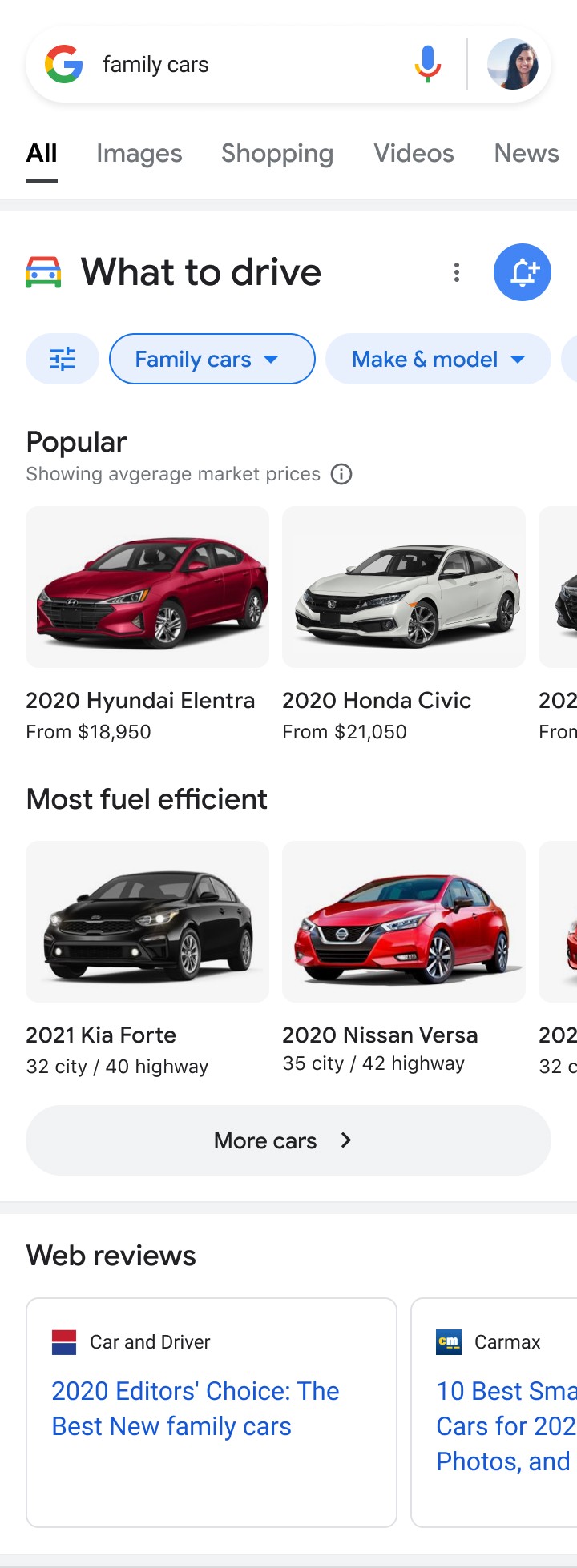
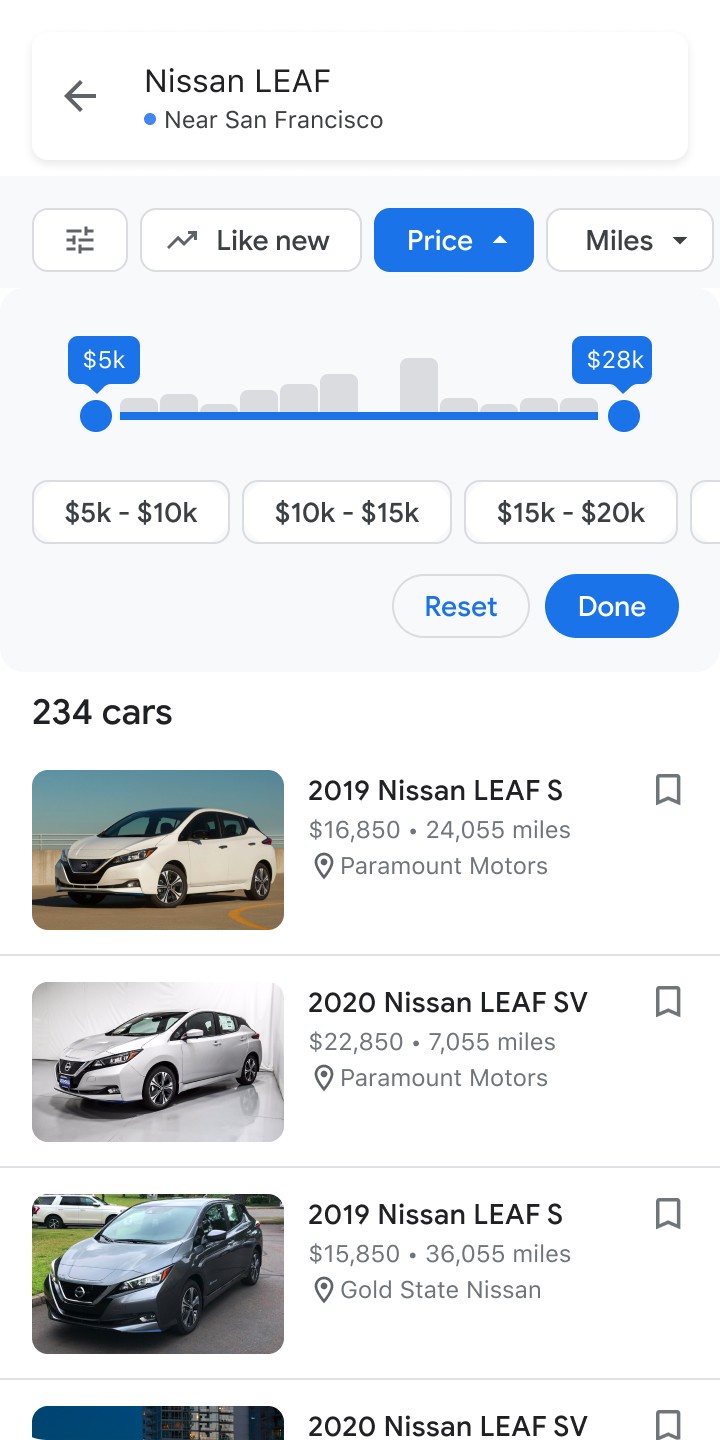
Once the motorcycle framework proved out in India, I extended it to cars in the US. The same spine, list, insight, compare, confidence, carried over cleanly, plus a final helping-to-make-a-purchase step connecting buyers to local inventory and dealers.


Impact
Both launches blew past expectations
Each sub-vertical was expected to deliver ~5% query growth and 1% category growth. Both launches blew past that. This expereince is 100% launched for motorcycles (India) and cars (US).
+32.8%
Commercial query growth, against target 5%
+6.46%
category query growth, against 1% target
13B
Annual auto queries
Some proprietary information has been modified for presentation purposes.
Evolving in the new AI era
The same problem, now met by AI that knows the path, and knows you.
The shipped framework gave the journey a spine, but the harder pain points stayed: knowing what fits your life, weighing tradeoffs you can't picture, picking back up without starting over. As Google's generative-AI capabilities matured, I led a vision sprint to reimagine the journey end-to-end.

A concise, helpful shortlist

Stitch complex info together

Compare and narrow down

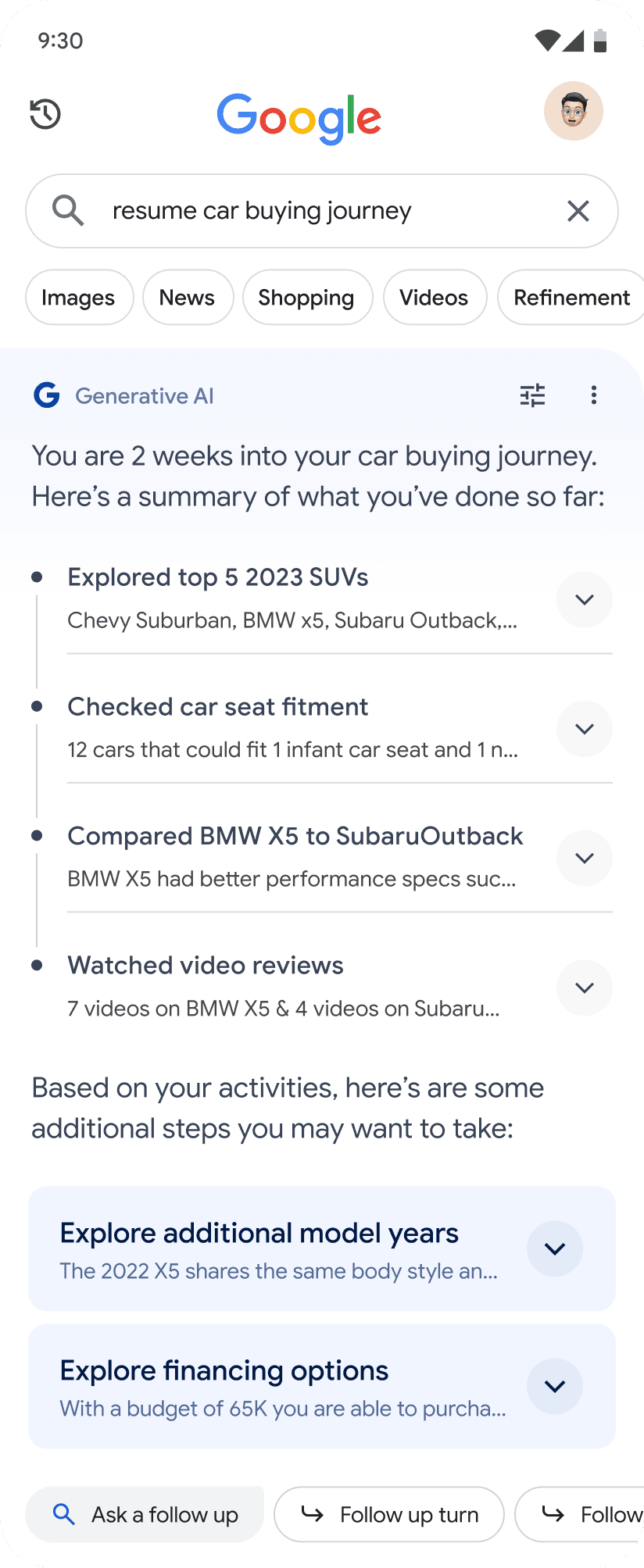
Jump back in & adapt
The north-star, end to end
The four moments of the AI-guided journey, each closing a pain point that pure information couldn't.
The vision shows the full arc: a concise list, intuitive visualization of fit, side-by-side comparison, and the ability to pick the journey back up weeks later with everything remembered.

A concise, helpful shortlist

Stitch complex info together

Compare and narrow down
Jump back in & adapt
Reflection